Standing by the Hoan Kiem Lake I saw the circular reflection
of Hanoi's cityscape on its calm waters. Modern Asia blended with French style.
After years of recovery, Hanoi was a brilliant star again. The still-life portrait
entranced me and I was hooked on Hanoi.
Next morning, 6:00am, I savoured coffee, a fresh tasty baguette, and pho noodle
soup before I headed back to the water. All around the circular lake Vietnamese
- young and old, male and female - were practicing tai chi, aerobics, running,
walking, badminton, meditation and playing flutes.
The rhythmic calmness of their movements was in harmony with
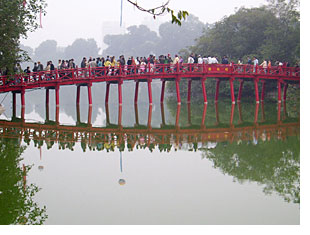
the misty dawn peeking over the Buddhist temple on a tiny island connected to
the shore by a bright-red bridge.
 Finishing my
stroll, I headed into the dynamic Old Quarters now celebrating its 1000th year.
During the last 800 years it has been the commercial heart of Hanoi. Hurly-burly
action pervaded every narrow street, though old trees seductively trailed their
branches over young women cooking thin pancakes on grills.
Finishing my
stroll, I headed into the dynamic Old Quarters now celebrating its 1000th year.
During the last 800 years it has been the commercial heart of Hanoi. Hurly-burly
action pervaded every narrow street, though old trees seductively trailed their
branches over young women cooking thin pancakes on grills.
Beautiful girls carried fresh produce on a traditional don ganh,
the ancient bamboo pole across the shoulders with a basket of rice hung on each
end, while men sat around low tables in courtyards and sipped their tiny cups
of coffee.
Market shops burst with fresh green leafy vegetables, buckets
of live fish flicking their tails, and an array of fruit that bedazzled the palate
- elegant dragon fruit, lumpy jackdaws, branches of lichees, golden mangoes and
infant-size bananas.
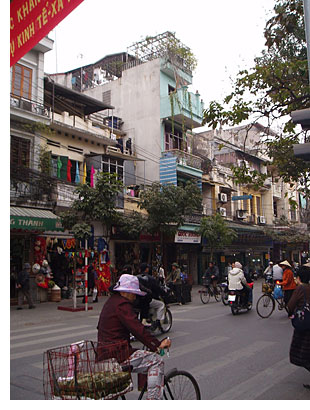
I noticed that the streets - lined with three-storied narrow building with residences
above the street-level shops - changed their names to match the type of stores
on them. Pho Hang Gui was the street for silk shopping because every shop had
silks by the yard or silk outfits or embroidered silk for sale.
 I
couldn't resist the traditional ao doi, a long sleeve Chinese tunic slit up the
side to the waist with fitted long pants, that looked as delectable in the windows
as they did on women walking by or riding bikes.
I
couldn't resist the traditional ao doi, a long sleeve Chinese tunic slit up the
side to the waist with fitted long pants, that looked as delectable in the windows
as they did on women walking by or riding bikes.
Days easily could be spend wandering the maze of busy streets and alleys that
ended in places that had no beginnings and challenges of returning to where I
started. But the mellow temperatures and the seductive passion to find just one
more different place nudged me on until I found the French Quarters.
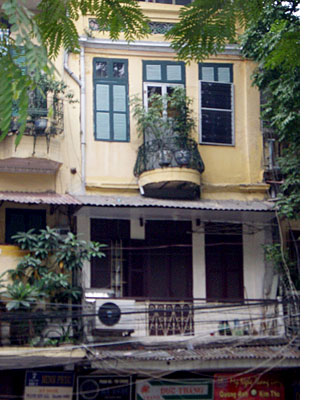
There I stayed awhile. Elegant buildings with long shutters,
balconies and flowers brought back the past when the French were in this country.
Along Pho Nha Tho Street, were multi-cultural restaurants, including
two good French ones, coffee bars, cafes, and boutiques of finely designed clothes,
lacquered dishes, and household items.
At the end sat St. Joseph's Cathedral with startling stained-glass
windows and opened doors spilling songs out over the square.
Next day, in the large modern part of Hanoi, I saw culture existing side-by side
with commerce. Hotels, cafes and restaurants were scattered among offices and
businesses all over the city. The Opera House was down the street from the Water
Puppet theatre and concert halls to make choices easy.
My experience getting into the Ho Chi Minh Mausoleum, the number one place of
pilgrimage for the Vietnamese, was novel. On either side of the long lines of
people going into the mausoleum were soldiers with rifles to guarantee orderly,
respectful behaviour.
Its museum provided abundant information about a leader who
had made such a difference in recent history. No one, I found, wants to talk about
the past war that we saw years ago on television. The present and future was the
focus.
On the edge of Hanoi, the Museum of Ethnology was impressive. Inside, displays
illustrated the diversity of Vietnamese culture and, outside, replicas of homes
of the various Minority People - a title used for their aboriginal tribes - were
situated in parklands. Visitors and local residents together admired this world-class
museum.
Afterwards, the best part to see be was with people sitting in coffee bars all
over the city watching the world change, as they conducted business deals.
It appeared that Vietnamese were born business-people: always
creative, working hard from sunrise to sunset, and selling skillfully. I wished
I had a suitcase to fill with the exquisite products sold at such reasonable prices.
Cuisine always has enhanced a country. An old Vietnamese proverb said people should
learn to eat before they learn to speak. In Hanoi people were always eating in
public.
Their cooking was a series of still life gems whose tastes satisfied
my every longing.
I tried many types of food, from pho, a soul-satisfying noodle
soup for breakfast - to regional dishes, such as cao lau, flat noodles stirred
together with croutons, bean sprouts, greens and pork.
When I desired a taste of home, meals in French and Italian
restaurants transported me.
All of this adds up to a beautiful city to visit, but the clinching fact is that
everything in Viet Nam costs less than it does in most any other countries. You
definitely can visit this grand city without harming your bank account.
Hurry now to Hanoi.
This week Traveling Tales welcomes author and freelance travel
writer Sandra Harper who makes her home in Vancouver, on Canada’s West Coast.
Photo choices:
1: Morning reflections on Hoan Kiem Lake.
2: The Old Quarters, the commercial heart of Hanoi.
3: Very narrow buildings identify the French Quarters..
If you go:
For assistance in planning your trip go to
www.footprintsvietnam.com
 Late
one January afternoon I arrived in the center of Hanoi, the capital city of VietNam
The sun sets early in the winter so the first thing I did was rush to one of the
lakes that dot the city to savour the warmth.
Late
one January afternoon I arrived in the center of Hanoi, the capital city of VietNam
The sun sets early in the winter so the first thing I did was rush to one of the
lakes that dot the city to savour the warmth.